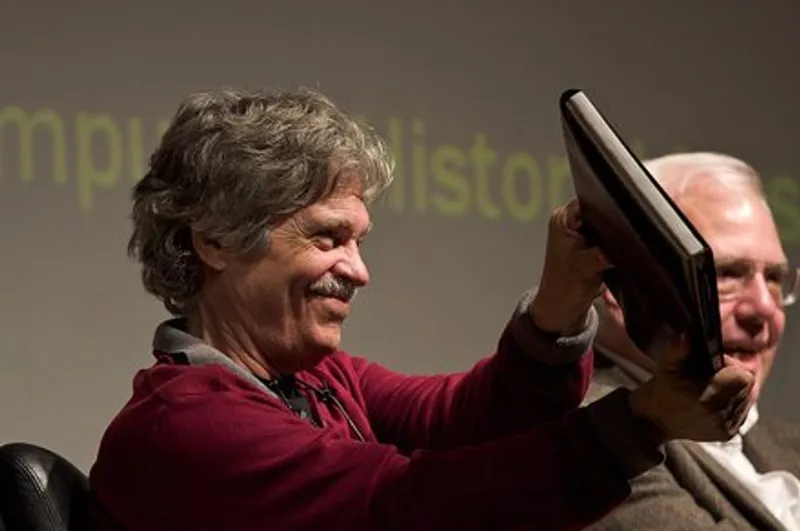
Alan Kay (born 1940) is an American computer scientist known for pioneering work on object-oriented programming and graphical user interfaces. His vision of personal computing, conceived in the late 1960s, predicted modern laptops and tablets.
Early Influences
Kay was influenced by Seymour Papert’s work on children and computing, Ivan Sutherland’s Sketchpad, and the Simula programming language. These converged into his vision of computing as a new medium for human expression and learning.
The Dynabook Vision
In 1968, Kay conceived the Dynabook—a portable computer for children that would be as personal as a book. Though never built as he envisioned, this concept drove his work on making computers accessible and easy to use.
Creating Smalltalk
At Xerox PARC in the 1970s, Kay led the team that created Smalltalk. The language embodied his philosophy that “simple things should be simple, complex things should be possible.” Smalltalk’s influence extends far beyond the language itself—it introduced the IDE, MVC architecture, and unit testing.
Philosophy of Computing
Kay views the computer as a “meta-medium”—a medium that can simulate and combine all other media. He advocates for computing education that teaches children to think algorithmically and create their own tools. His famous quote, “The best way to predict the future is to invent it,” captures his proactive approach to technology.
Awards and Recognition
Kay received the Turing Award in 2003 for his work on object-oriented programming. He continues to advocate for improving computing education and has been critical of modern software for failing to live up to early visions of personal computing.