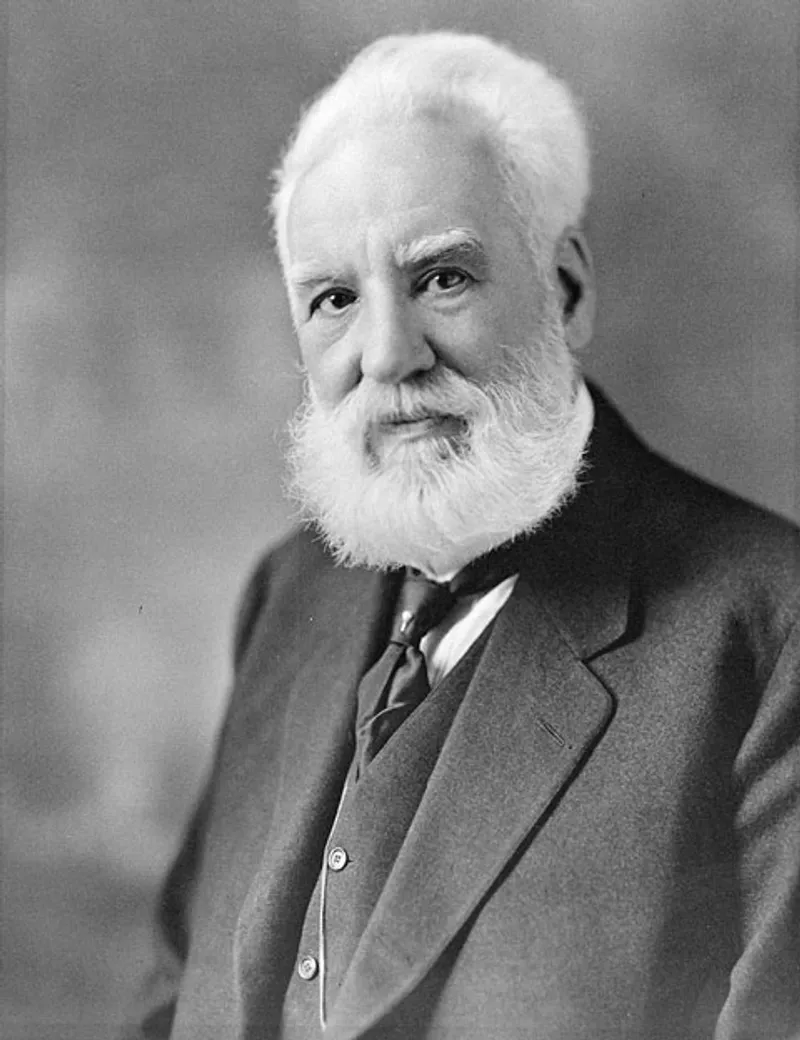
Alexander Graham Bell (1847–1922) was a Scottish-born American inventor, scientist, and teacher of the deaf whose invention of the telephone in 1876 fundamentally transformed human communication and laid the groundwork for the modern telecommunications industry.
Early Life and Education
Bell was born on March 3, 1847, in Edinburgh, Scotland, into a family deeply involved in the study of speech and sound. His father, Alexander Melville Bell, was a professor of elocution and developed “Visible Speech,” a system of symbols representing the position of speech organs. His mother, despite being deaf, was an accomplished pianist whose condition profoundly influenced Bell’s life work.
Bell was educated at the Royal High School in Edinburgh and later at the University of Edinburgh and University College London, though he never completed a formal degree. In 1870, following the deaths of both his brothers from tuberculosis, the family emigrated to Canada, settling in Brantwood, Ontario.
Teaching the Deaf
Bell moved to Boston in 1871, where he opened a school for training teachers of the deaf and became a professor of vocal physiology at Boston University in 1873. His work with deaf students, including Mabel Hubbard (who later became his wife), drove his research into sound transmission and acoustics[1].
Invention of the Telephone
Bell’s work on the “harmonic telegraph”—a device to transmit multiple telegraph messages simultaneously—led him toward voice transmission. Working with assistant Thomas Watson, Bell filed his telephone patent on February 14, 1876, just hours before competitor Elisha Gray filed a similar patent caveat[2].
On March 10, 1876, Bell transmitted the first intelligible speech by telephone, famously saying: “Mr. Watson, come here—I want to see you.” The U.S. Patent Office granted Patent No. 174,465 on March 7, 1876—often called the most valuable patent ever issued.
Building an Industry
In 1877, Bell and his partners founded the Bell Telephone Company, which eventually became AT&T (American Telephone and Telegraph Company). The company grew rapidly, and by Bell’s death in 1922, telephone technology had spread worldwide.
Later Innovations
Bell continued inventing throughout his life:
- The Photophone (1880): A device that transmitted sound on a beam of light—a precursor to fiber optic communication. Bell considered it his most important invention.
- The Metal Detector (1881): Developed in an attempt to locate the bullet in President James Garfield after his assassination.
- Hydrofoils: Bell developed high-speed hydrofoil watercraft, with his HD-4 setting a world marine speed record of 70.86 mph in 1919.
Legacy
Bell received numerous honors, including the French Volta Prize for electrical science. When he died on August 2, 1922, all telephone service in the United States and Canada was suspended for one minute in tribute[3].
The bel (B) and decibel (dB) units of sound measurement were named in his honor by Bell Labs. His work not only created an industry but established principles of acoustic engineering that would later prove essential to computing, data transmission, and the digital age.
Sources
- Britannica. “Alexander Graham Bell.” Biography and context of his work with the deaf.
- History.com. “Alexander Graham Bell patents the telephone.” Details of the patent race.
- Wikipedia. “Alexander Graham Bell.” Comprehensive biography and legacy.