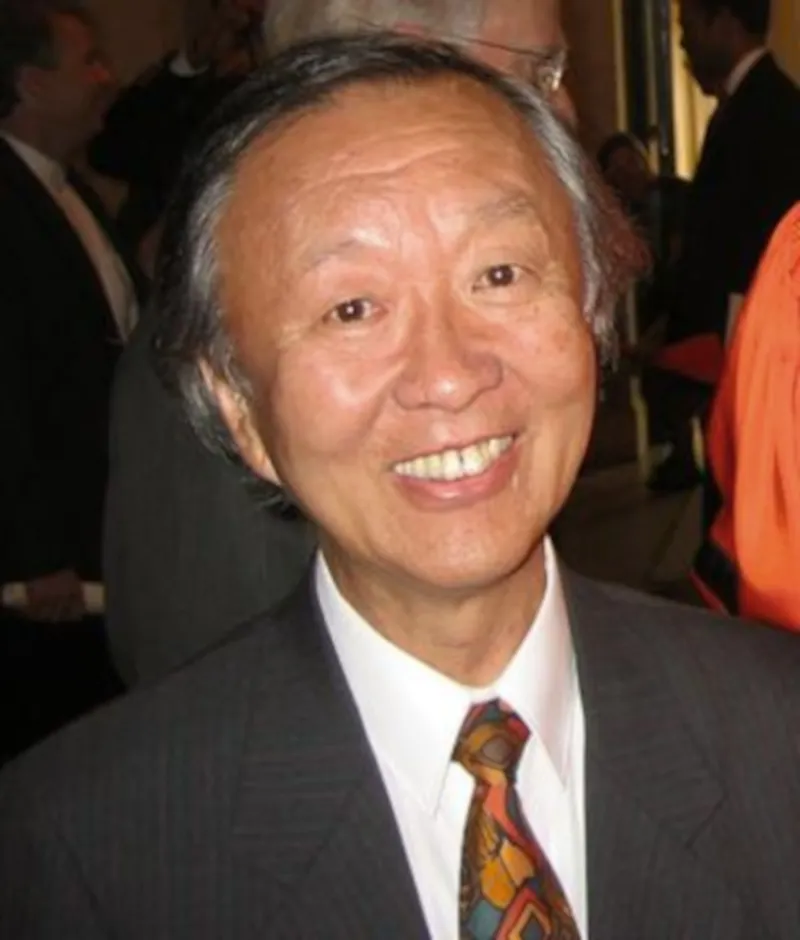
Sir Charles Kuen Kao (1933–2018) was a Chinese-British-American electrical engineer and physicist who discovered how to transmit light through fiber optic cables over long distances, enabling the global telecommunications infrastructure that carries the internet today. His 2009 Nobel Prize in Physics recognized “groundbreaking achievements concerning the transmission of light in fibers for optical communication.”
Early Life and Education
Kao was born on November 4, 1933, in Shanghai, China, into an affluent family. His father was an academic lawyer and his mother a poet. Educated at home before attending French- and English-speaking schools, Kao developed an early interest in chemistry and physics[1].
In 1948, amid the Chinese Civil War, Kao’s family moved to Hong Kong, then to England in 1953. He studied electrical engineering at Woolwich Polytechnic (now the University of Greenwich), graduating in 1957. While working at Standard Telecommunication Laboratories (STL) in Harlow, Essex, he earned his Ph.D. in electrical engineering from University College London in 1965.
The Fiber Optics Breakthrough
In the early 1960s, optical fibers could only transmit light for about 20 meters before the signal degraded beyond usefulness. Most scientists assumed this was an inherent limitation of glass.
Working with colleague George Hockham at STL, Kao conducted careful research showing that the high loss in optical fibers was not fundamental to glass itself but was caused by impurities. In their landmark 1966 paper “Dielectric-fibre Surface Waveguides for Optical Frequencies,” they demonstrated that ultra-pure glass fibers could theoretically transmit light signals over 100 kilometers[2].
This insight was revolutionary. Kao calculated that if glass purity could reach 99.9999%, fiber optic communication would become practical. His paper ignited an international race to produce low-loss optical fibers.
Making It Real
Kao didn’t stop at theory. He traveled the world, visiting glass manufacturers and research institutions, championing fiber optics and encouraging development of ultra-pure glass. In 1970, Corning Glass Works produced the first fiber meeting Kao’s specifications—achieving less than 20 decibels per kilometer of loss.
By the 1980s, fiber optic cables were being deployed for telecommunications. Today, over 99% of international data traffic travels through undersea fiber optic cables based on Kao’s insights.
Later Career
Kao moved to the Chinese University of Hong Kong in 1970, where he established the electronics department. He later worked at ITT Corporation in the United States before returning to Hong Kong as Vice-Chancellor of the Chinese University from 1987 to 1996[3].
Nobel Prize and Recognition
In 2009, Kao received the Nobel Prize in Physics, sharing it with Willard Boyle and George Smith (who invented the CCD sensor). By then, Kao had been diagnosed with Alzheimer’s disease (2004), and his wife Gwen accepted the prize on his behalf.
In 2010, Kao was knighted by Queen Elizabeth II for his services to fiber optic communications. He and his wife founded the Charles K. Kao Foundation for Alzheimer’s Disease to raise awareness about the condition.
Kao died on September 23, 2018, in Hong Kong at age 84. His legacy includes not just the billions of miles of fiber optic cable encircling the globe, but the very infrastructure that makes the modern internet possible.
Sources
- Nobel Prize. “Charles K. Kao – Biographical.” Early life and education.
- Nature. “Kuen Charles Kao (1933–2018).” His breakthrough discovery.
- Britannica. “Charles Kao.” Career and achievements.