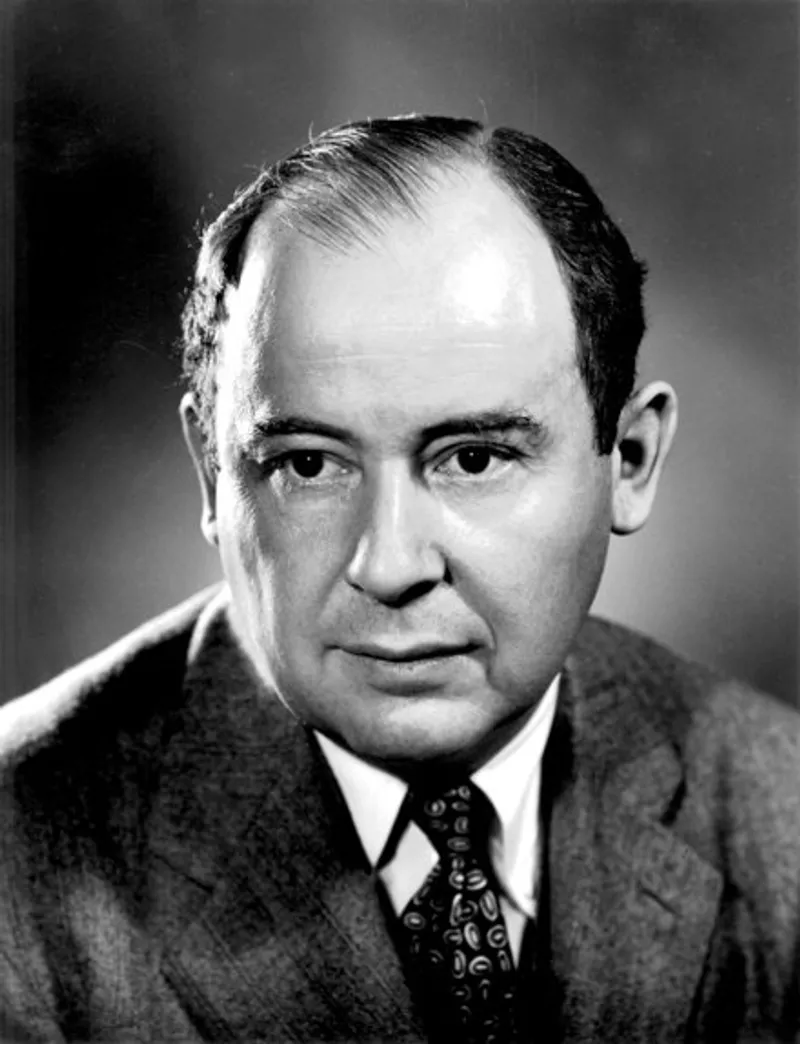
John von Neumann (1903–1957) was a Hungarian-American mathematician and physicist whose work shaped the foundations of modern computing. His 1945 report on the EDVAC established the stored-program architecture that remains the basis of virtually all computers today.
Early Life and Education
Born in Budapest, Hungary, on December 28, 1903, von Neumann was a child prodigy with a photographic memory who could memorize and recite entire phone book pages[1]. He received his PhD in mathematics from the University of Budapest in 1926 at age 22, while simultaneously earning a degree in chemical engineering from ETH Zurich.
In 1930, he emigrated to the United States and joined Princeton University. When the Institute for Advanced Study was founded in 1933, von Neumann became one of its first six professors at age 30—the youngest in its history—alongside Albert Einstein.
The Manhattan Project
During World War II, von Neumann consulted for the Manhattan Project at Los Alamos, where his mathematical expertise proved crucial for calculating the implosion dynamics needed to detonate an atomic bomb[2]. This work required massive computations, which drew him to the emerging field of electronic computers.
The EDVAC and Stored-Program Computing
In 1944, von Neumann learned about the ENIAC project at the University of Pennsylvania’s Moore School and joined as a consultant. While ENIAC was revolutionary, it required physical rewiring to change programs. Von Neumann participated in discussions about ENIAC’s successor, the EDVAC, and in 1945 wrote his famous “First Draft of a Report on the EDVAC.”
This document introduced the stored-program concept: keeping both program instructions and data in the same memory. The architecture it described—now called the von Neumann architecture—has five components:
- A processing unit with arithmetic and logic capabilities
- A control unit that directs operations
- Memory that stores both data and instructions
- Input mechanisms
- Output mechanisms
This design became the template for virtually every computer built since[3].
The IAS Machine
At the Institute for Advanced Study, von Neumann led the construction of one of the first stored-program computers, the IAS machine, which began operating in 1951. Unlike ENIAC’s decimal system, the IAS machine used binary arithmetic. Its design was freely shared and spawned numerous copies worldwide.
Game Theory and Other Contributions
Von Neumann’s 1928 paper established him as the founder of game theory. His 1944 book with Oskar Morgenstern, “Theory of Games and Economic Behavior,” transformed economics and influenced fields from evolutionary biology to military strategy.
He also made fundamental contributions to:
- Quantum mechanics (mathematical foundations)
- Operator theory and functional analysis
- Set theory
- Cellular automata (self-replicating machines)
Legacy
Von Neumann died of cancer on February 8, 1957, at age 53. His influence on computing is immeasurable—the von Neumann architecture remains the dominant paradigm for computer design. He received the Medal of Merit (1947), the Medal of Freedom (1956), and the Enrico Fermi Award (1956).
Sources
- IAS. “John von Neumann: Life, Work, and Legacy.” Biography from the Institute for Advanced Study.
- Britannica. “John von Neumann - World War II.” His work on the Manhattan Project.
- Wikipedia. “Von Neumann architecture.” The lasting influence of his computer design.