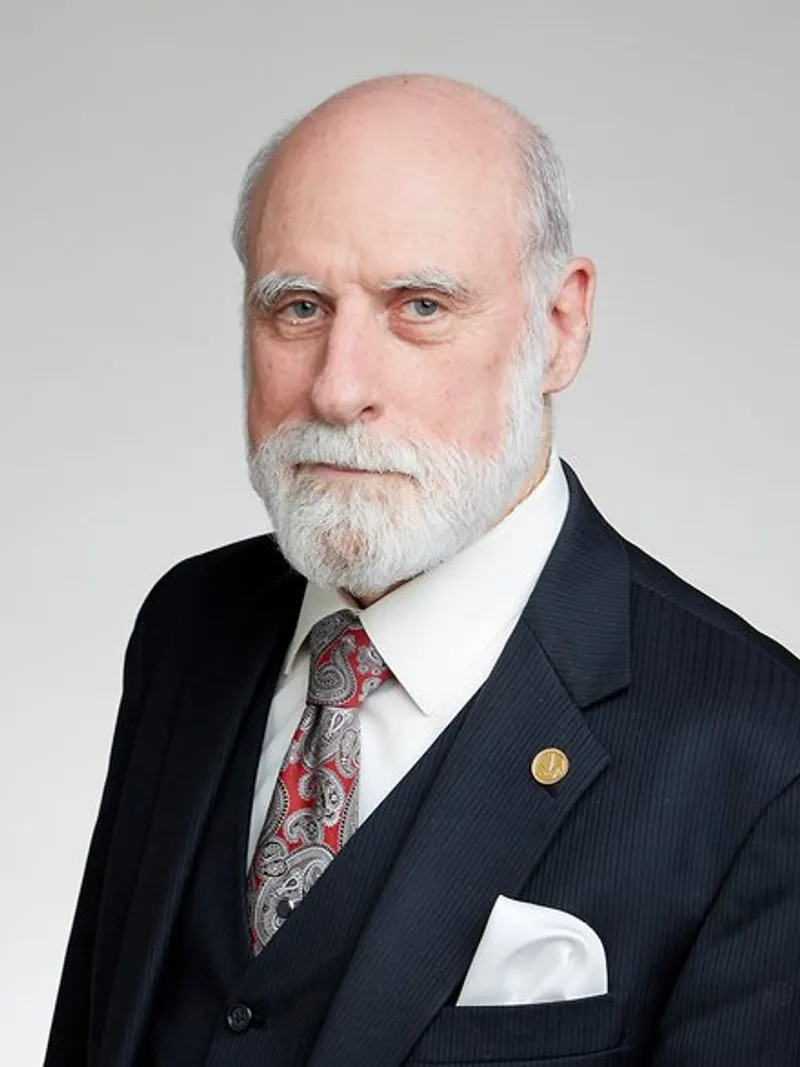
Vinton Gray Cerf is one of the architects of the Internet, having co-designed the TCP/IP protocols that allow computers worldwide to communicate. Along with Bob Kahn, he created the technical foundation that transformed a collection of isolated networks into the global Internet we know today.
Early Life and Education
Born in 1943 in New Haven, Connecticut, Cerf showed early aptitude for mathematics and science. He earned his bachelor’s degree in mathematics from Stanford University in 1965, followed by a master’s from UCLA in 1970 and a PhD in 1972[1].
At UCLA, Cerf worked on ARPANET as part of the team developing the network’s first protocols. It was here that he first collaborated with Bob Kahn and became deeply involved in the challenge of networking.
Creating TCP/IP
In the early 1970s, Cerf moved to Stanford as an assistant professor, where he continued his collaboration with Kahn, then at DARPA. The challenge they tackled was monumental: how to connect different networks—each with their own protocols, speeds, and characteristics—into a unified “internetwork.”
Their solution was TCP/IP (Transmission Control Protocol/Internet Protocol), published in 1974 in the seminal paper “A Protocol for Packet Network Intercommunication”[2]. The elegance of their design lay in its simplicity: IP handles addressing and routing packets between networks, while TCP ensures reliable delivery. This separation of concerns allowed the protocol to scale from a handful of research networks to the billions of devices connected today.
The Internet’s Growth
After Stanford, Cerf spent time at DARPA leading the Internet program, then at MCI where he helped develop MCI Mail—one of the first commercial email services. He was instrumental in the Internet’s commercialization in the 1990s.
In 2005, Cerf joined Google as Vice President and Chief Internet Evangelist, a role he continues today. He advocates for Internet access, privacy, and openness while working on challenges like interplanetary networking for NASA.
Recognition
Cerf has received virtually every major honor in technology, including:
- The Turing Award (2004, with Bob Kahn)
- The Presidential Medal of Freedom (2005)
- The National Medal of Technology (1997)
He is recognizable at tech conferences by his signature three-piece suits and his tireless advocacy for an open, accessible Internet.
Legacy
Cerf’s work on TCP/IP didn’t just create a protocol—it created a platform for innovation. Every website, every app, every connected device relies on the architecture he and Kahn designed in the 1970s. The Internet has become essential infrastructure for commerce, communication, education, and entertainment, touching billions of lives daily.
Sources
- Internet Hall of Fame. “Vint Cerf.” 2012.
- Cerf, V., Kahn, R. “A Protocol for Packet Network Intercommunication.” IEEE Transactions on Communications, 1974.